Inspired by the work of Bernard Lietaer and Jacqui Dunne
Their study reveals how our monetary system reinforces scarcity, and how communities are already using new paradigms to foster sustainable prosperity.
Globally our economies are stuck in an agonizing cycle of repeated financial meltdowns. Yet solutions already exist, not only for our recurring fiscal crises but our ongoing social and ecological debacles as well. These changes came about not through increased conventional taxation, enlightened self-interest, or government programs, but by people simply rethinking the concept of money.
In Rethinking Money, Bernard Lietaer and Jacqui Dunne explore the origins of our current monetary system—built on bank debt and scarcity—revealing how its limitations give rise to so many serious problems. The authors then present stories of ordinary people and communities using new money, working in cooperation with national currencies, to strengthen local economies, create work, beautify cities, provide education, and more. These real-world examples are just the tip of the iceberg—over four thousand cooperative currencies are already in existence.
The book provides remedies for challenges faced by governments, businesses, nonprofits, local communities, and even banks. It demystifies a complex and critically important topic and offers meaningful solutions that will do far more than restore prosperity—it will provide the framework for an era of sustainable abundance.
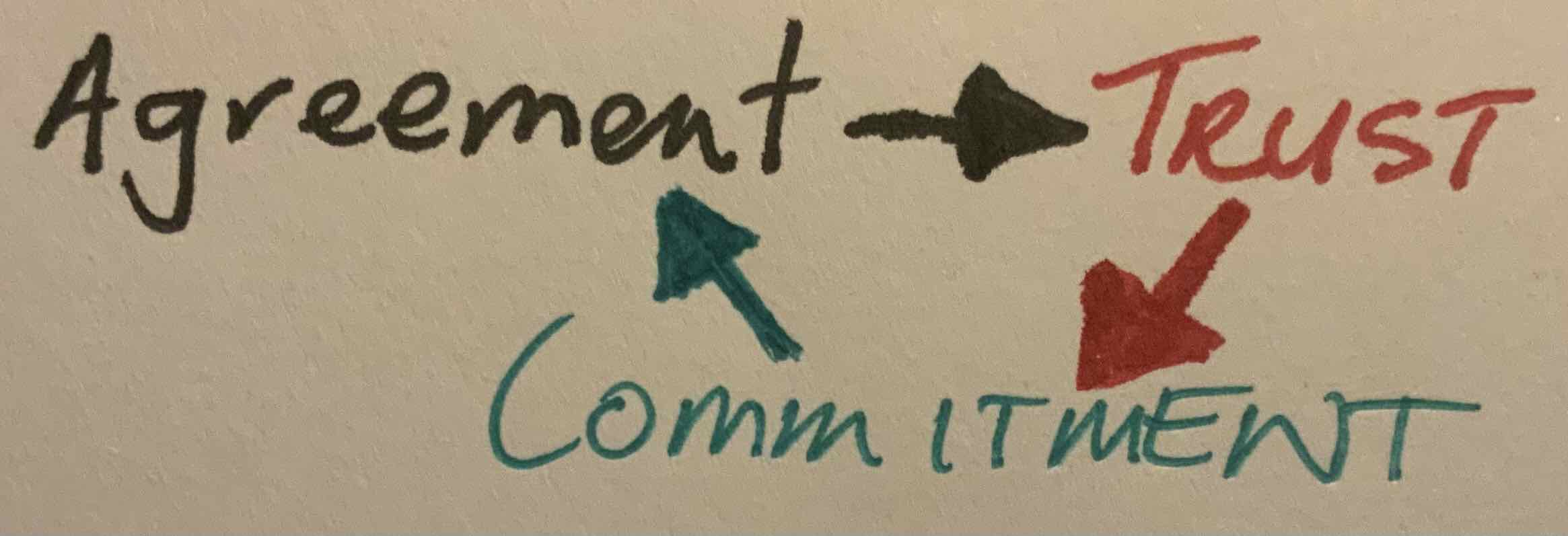
- Agreement is the essence of Value! – money only has value because we agree it does.
- Trust is the basis of agreement
- Trust is created through the interdependent sharing of commitments (Promise Theory Bergstra and Burgess 2014)
Economic Commons: a Mutual Aid based commitment sharing Game.
- Each player defines their commitment to the game by:
- Determining the unit of account of their commitment i.e. time minutes; A particular service; A general service in an area; product.
- Relative weighting of the commitment in terms of the unit of account i.e. 30 minutes; 12 eggs
- How many are available to be circulated. This is the exposure of the commitment which affects how reliably it can be redeemed at some point in the future.
- Each player creates their physical commitment vouchers.
- Start exchanging commitment vouchers between players and see what happens.
You could collectively define some parameters for the game i.e. A mission; objective; or vision.
At anytime anyone can press the pause buzzer and implement a process review with a view to refining the Game flow.
You could even invent your own rules (collective agreements that become a kind of lore for your communities’ version of the game) . For example each player could be given the agency of flexible trust in the sense that they could refuse to accept certain vouchers as payment where they don’t trust that the commitment behind the voucher will be fulfilled if and when they try and redeem it.
For a brief technical specification to implement a decentralised blockchain and data sharing software application that would facilitate the Game please see the previous post.
 A Radical Shared Economy
Leave a comment