
Economic Commons
A Stellar Decentralised Commitment Sharing Protocol (#DCSP)
Think of it like the karmic ledger in real time
like Monopoly but it is not a bored game, it is exciting!
It uses 56 bit encrypted keys and creates economies of
Abundance based on Reciprocity
A Radical Shared Economy
Agreement -> Trust -> Commitment
5 key concepts
1) Agreement is the essence of Value
A) Monopoly money has value because all the players agree it does. Value = agreement or social contract.
B) Metcalfe’s Law with regards “network effects” states that the value or influence of a network is proportional to the number of nodes / users squared, which implies that with each additional user the possible connections on the network increase by the total number of users minus one. This same law can be applied to value itself in the sense that a particular value’s influence is proportional to the number of entities squared that agree with that value and have access to it.
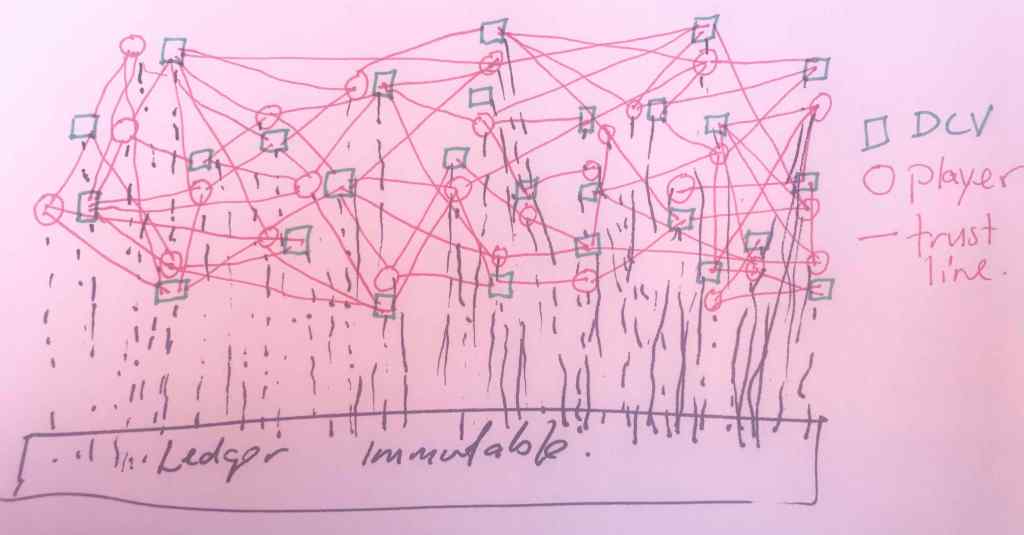
2) Immutable Ledger
A) A public permission less blockchain ledger is a neutral and transparent source of the truth. Truth is no longer for sale by third party elite organisations who previously monopolised centralised access i.e. banks
B) Each value exchange is immutably recorded on the ledger. Value exchanges are signed atomically using 56 bit encrypted keys.
C) Can’t change the past everything is archived and everyone has equal open access to the archive, you can only append.
D) The doble spend problem is solved through a decentralised secure consensus algorithm (al-Khwarizmi). How the distributed network hosting the ledger reaches consensus matters.
3) Perverse Incentives and Consensus
A) Interest is the key mechanism through which banks operate (achieve consensus about the state of the ledger of the financial system) and is a perverse incentive in the sense that it encourages the hoarding of financial resources.
B) Proof of stake is similarly perverse in the sense that it provides incentives for staking digital assets to secure consensus for the network. Proof of work incentivises nodes that secure the network by providing compute power to solve complex mathematical problems. Any incentive based consensus is perverse in its very nature, because it encourages the centralisation of resources by virtue of the fact that having more of the asset that incentivises consensus is the implied objective.
C) The stellar decentralised network uses social contract as the basis for consensus through the agency or flexible trust. Consensus itself is the incentive to reach consensus.
D) Instead of offering interest or rewards for staking assets to secure consensus, demurrage (rent paid for each piece of state on the live ledger) is used to prevent the hoarding of network resources which in turn encourages their even distribution throughout the community.
4) Flexible Trust
A) Each player votes with their trust as to what has value to them or what they agree with. The trust lines enable players to demonstrate what they agree with, this then forms the basis of the social contract.
B) According to Bergstra and Burgess’ (2014) promise theory, trust is built through the interdependence and flow of commitments
5) Digital Commitment Voucher (DCV)
A) Each players’ commitment to the community is digitised on the immutable ledger as unique vouchers (DCVs).
B) Elastic trust lines connect players to other players’ DCVs and can be either connected or withdrawn, thus permitting or preventing value exchanges between the entities. This enables each player to demonstrate which DCVs they trust at any point in time.
C) Standardised DCV nomenclature contains:
- Amount minted
- ID
- Unit of Account
- Relative Weighting
D) Standardised Nomenclature allows for DCVs (shared commitments) to be exchanged interchangeably peer to peer in a decentralised and diverse ecosystem of shared value. Where the agency of flexible trust is the implicit self regulating mechanism of the community (federated system of players), which is analogous to how a forest (federated system of trees) regulates itself.
Roots of Inspiration
Immense gratitude to the following people and their ideas that provided the main inspiration for this site
Robin Wall Kimmerer
- The Serviceberry: an Economy of Abundance https://emergencemagazine.org/essay/the-serviceberry/
- Sky Woman Falling https://emergencemagazine.org/op_ed/skywoman-falling/
- Corn tastes better on the honor system. https://emergencemagazine.org/feature/corn-tastes-better/

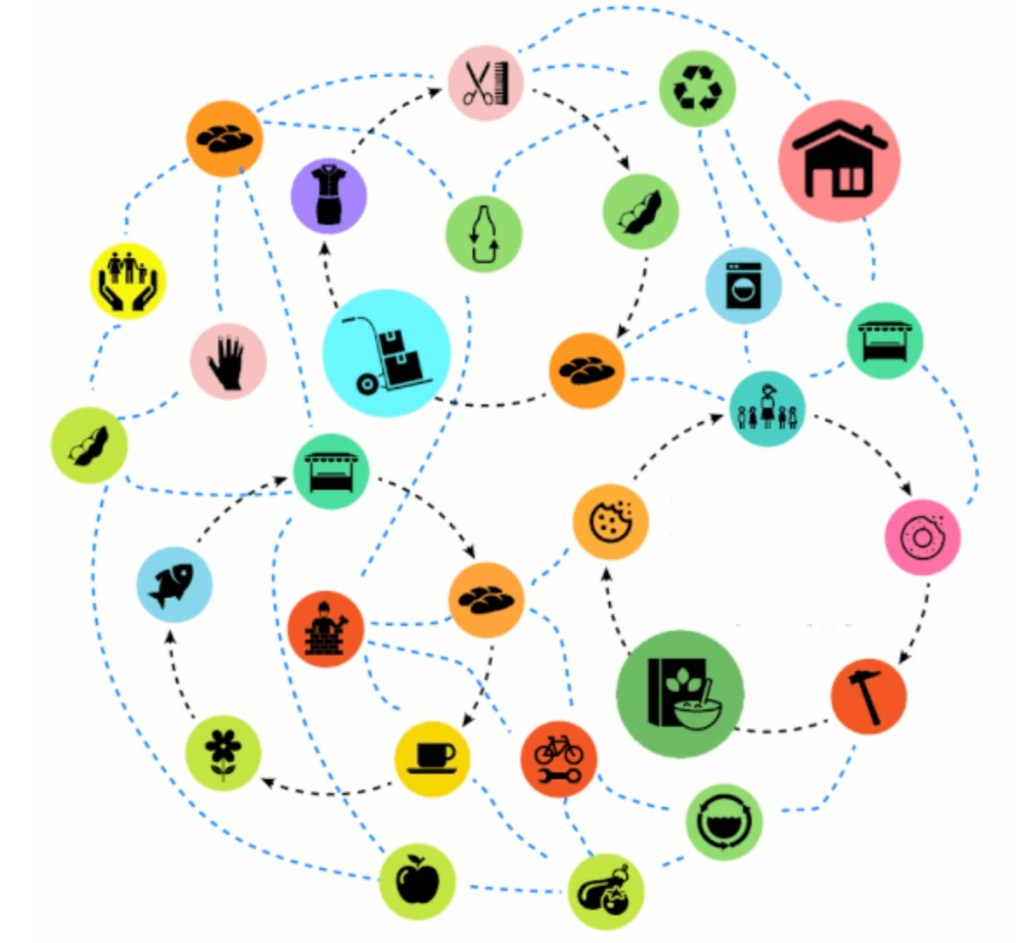
Will Ruddick and Grassroots Economics
- Commitment Pooling: an Economic Protocol inspired by Ancestral Wisdom https://ijccr.net/wp-content/uploads/2024/05/54-79-ijccr-2023-4-ruddick.pdf
- Grassroots Economics https://www.grassecon.org/
- https://willruddick.substack.com
David Mazieres
- Stake Reputation not Cryptocurrency https://www.youtube.com/watch?v=5sMtaifisZA
- Stellar Consensus White Paper https://stellar.org/learn/stellar-consensus-protocol
- David’s Teaching and research http://www.scs.stanford.edu/~dm/

 A Radical Shared Economy